Showing posts with label thistlepanel. Show all posts

Tuesday, October 6, 2009

Peggy Tudor: Another (minor) Milestone

It took a while, I must admit, but I have finally finished the fourth piece of my Peggy Tudor sweater. This is the left front, which matches the previous piece (i.e. the right back) for all patterns & shaping except at the neck/shoulder. In the process of knitting this piece, I actually discovered a minor flaw in the armhole shaping on the previous one, which I decided to go back & fix, since it would only take a couple of extra hours. It's such a big project overall that I knew the tiny delay would hardly matter. After ripping back, I ended up knitting the two pieces in tandem for several inches, using one circular needle of adequate length to hold them both. The results were very gratifying. Indeed this approach made it so easy to ensure that the two pieces actually matched row-for-row that I have decided to work the next two (i.e. the left back & right front) together from the start. It will take twice as long to finish them both that way, but then I'll be done with the four largest pieces (i.e. most of the body) & ready to start on the sides of the sleeves.

Here are the customary photos of the latest work, including one of the new piece by itself and another that shows it side-by-side with the now corrected previous segment. As always, click on either one for a larger view. Depending on your browser settings, it may take an extra click or two to zoom in all the way.


One interesting feature of the design that is not entirely obvious from the photo spread in the Tudor Roses book (splendid as that is) is the special pattern at the shoulder seam of the side front, consisting of three horizontal rows of knots (or knitted beads or, I suppose, even nupps) on a stockinette background, alternating with bands of reverse garter stitch. The knots are a little hard to see in this picture, but after blocking I think they will stand out nicely. Although this sweater is obviously designed to be knitted in many pieces and eventually sewn together, this pattern detail masking the shoulder seam reminds me somewhat of the traditional "shoulder straps" seen in fishermen's guernseys such as Stornoway, which are knitted in-the-round.

I think I have said it before, perhaps even more than once already, but it deserves to be repeated and emphasized: this is an *astonishingly* intricate design. Such painstaking attention to detail!! The placement of every stitch has been meticulously arranged, and NOTHING in the pattern happens by accident or even by default. I continue to be blown away by the degree of technical control displayed here over & over again.

I should also add that the NatureSpun sport-weight yarn is like a dream come true. Its softness and drape will make for an eminently wearable sweater when all is said and done — not to mention the snuggly warmth of 100% wool — and yet the stitch definition is crisp and clean, leaving nothing to be desired. I would whole-heartedly recommend this yarn choice to anyone searching for an alternative to the 5-ply guernsey wool.

Thursday, July 30, 2009

Peggy Tudor: Our Little Girl Is Growing Up

The third Peggy Tudor panel is now complete!! It took quite a bit longer than the first two, partly because it's at least twice as large and also because I got a bit distracted with other projects (the Fjörgyns, Stornoway, entrelac, etc.). Note the pattern at the side-seam (previously seen only in the swatches). I love the way it echoes the undulating curve from the edge of the thistle panel. Click on either image for a closer look.

Three down, thirteen to go...

Saturday, July 4, 2009

Of "Dagging" & "Slashing"

Dagging & slashing. They sound like primitive combat tactics, don't they?

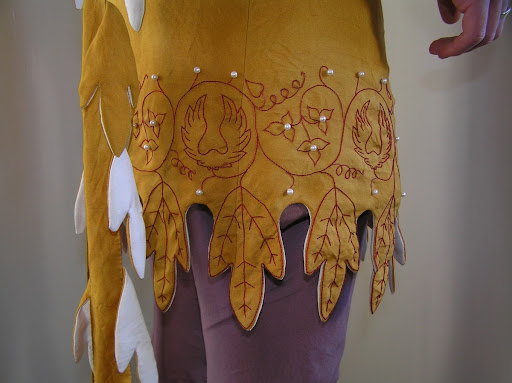
But these terms are not meant to invoke either violence or bloodshed. For they refer to two fancy tailoring techniques that became popular in Europe from the 14th to the 16th centuries for the embellishment of elegant garments.

Dagging is a decorative hem created by pointed motifs, or dagges, that are cut into the edge of a sleeve or the bottom of a blouse or tunic. These could be simple U or V shapes or sometimes more complex designs.

Slashing (also known as "slash-fabric" or "faux chenille") is when multiple layers of contrasting fabric are sewn together and the upper layers artfully sliced open to reveal the colors beneath. The story is told that the technique originated when certain soldiers of the Swiss army sought to keep warm by cutting scraps of material from tents & banners and stuffing them into the chilly holes in their clothing. Upon their return home, the colorful effect of this act of desperation sparked a whole new fashion trend!


Whence comes this sudden interest in tailoring techniques from so long ago? Note the following remark from the pattern notes, explaining the unusual design of the Margaret Tudor sweater:

Slashing is a sophisticated facet of the tailor's art that became extremely fashionable throughout Europe in the 1500s. I have transferred the concept to knitting, together with the strong emblems of The Thistle and The Rose.

So that is why the pattern consists of many individual narrow strips that must then be carefully sewn together. The undulating edges of the thistle panels are designed to overlap the rose panels in such a way as to create "windows" or frames that display the openwork underneath.

As the photo shows, I finished the second thistle panel yesterday. It will be the center front. Notice that unlike the back it ends with a complete motif at the top.

Since the front and the back each have two rose panels flanking the center, and the sleeves each have one down the middle, these first two thistle panels are the only ones with the undulating edges on both sides. The remaining ones will all have that pattern on one side, with the garment shaping of sleeve edge or armhole on the other.

Thursday, July 2, 2009

Defying Gravity

It's uncanny. Call it a Law of Nature. Certain things *ALWAYS* seem to happen, no matter what I do.

When cutting out a new sewing project, for instance, at some point I will inevitably spill my box of pins.

When hand sewing, at some point I will inevitably drop my needle in a random direction and have to hunt all over for it.

And when knitting cables, I will inevitably keep losing track of the @#%&^!! cable needle.

I have been known to slip cable stitches off the needles into mid-air and perform the twists manually, just in order to avoid having to use, and more to the point keep track of, a cable needle.

It's become sort of a sad joke in my life, really.

Things like this bring out my native Slavic fatalism in a big way. You know what I mean: you're not paranoid, those really ARE German Panzer units on the horizon...

Peggy Tudor has some delicate cable work that requires careful attention, and the assistance of a cable needle can be invaluable. So lately, in connection with the thistle panels, I have frequently had to stop & grope around next to me and/or UNDER me, because the silly thing has slipped away & made another bid for freedom.

I have tried all of the obvious fixes, like sticking it in my knitting, or in the skein, or on my lap, or in my mouth. None of them seem to help.

Frustrating doesn't even begin to touch this.

So I was complaining about it last week at that gathering of knitters in Louisville, where the entrelac concept for my Spring Bouquet yarn got its big vote of confidence. The ladies made various creative suggestions, and I admit I was rather dubious at first.

But yesterday, after tracking down the elusive cable needle for the third time in approximately 11 minutes, I finally decided that enough was enough and put one of the ideas to use.

I got some stray bulky yarn out of my stash, and knitted a small seed-stitch rectangle, just the right size to hold the cable needle securely, so that I can pin this object to a convenient spot on my clothing while I am knitting and always have it to hand.

I am happy to report that this embarrassingly simple solution works like an absolute charm. It has *SOLVED* my perennial problem. Gravity is no longer a predatory influence on my cable knitting.

Take that, Isaac Newton!!

Wednesday, July 1, 2009

Peggy Tudor: 1st whole panel

Last night I finally finished the first panel for Peggy Tudor!!

Here it is.

One down, and "only" 15 more to go.

That's 5 each front and back, plus 3 for each sleeve.

So this is just the first big milestone.

I've got some *serious* knitting ahead of me.

But it's lots of fun (even if the pattern requires a bit of concentration).

This will be the center back.

As you can see, there's a partial motif at the top (18 out of 44 rows).

That's in order to allow the center *front* to end on a complete thistle at the neckline.

So this panel consists of (5 x 44) + 18 = 238 rows.

It is a long skinny panel.

I love the elegantly undulating edges with their touch of lace.

They will become a striking feature of the finished sweater.

Of course, what I have here is a LONG SKINNY PICTURE to mark the occasion.

Hence the short, choppy paragraphs, because I needed to fill the space.

TA-DAAAH!!

Monday, June 22, 2009

The devil really *IS* in the details.

What can I say? That thistle panel chart for Peggy Tudor is in a class by itself. I have done a fair bit of complex chart-based knitting in my day — including lace patterns that spread over several pages — but I've never seen anything quite like this. It contains 19 or 20 different symbols, at least half of which seem *specifically* calculated to create left-right directional headaches for someone like me.

Mind you, any malice aforethought in all of this must be attributed to the cussedness of the universe in general and not to the designer. There is nothing wrong with the pattern itself. Indeed the instructions explicitly state:

Reading odd numbered (RS) rows from right to left and even numbered (WS) rows from left to right, beg at row 1 and work the patt from chart A...
As long as you can do that, the chart is perfectly clear and unambiguous, with all the little devilish details put meticulously in their proper places. But as a left-handed knitter I always have to pay extra attention to what I am doing to avoid mix-ups, even with relatively simple patterns. So this is just an extreme case of something that I deal with every day. C'est la vie.

In the course of reworking the first thistle after my last post, I actually identified two more places where I had misread the chart. So I am very, VERY glad to have taken the time to work out all these little kinks at this early stage. Now is the time. It would be rotten to discover problems of this nature with the project any further along, that's for sure.

Here is the new & improved first thistle. It will need careful blocking of course (oh, really?), but I think the knitting is as accurate as I can ever expect to make it. Click on the image, as always, to get a closer look.

Sunday, June 21, 2009

Nobody's perfect, but...

Can you spot it? Look very, VERY closely.

There is *one* tiny mistake in the first thistle that I so triumphantly photographed and put on display in my previous post a little while ago. One itty bitty 2-stitch cable that twisted the wrong way. I only just noticed it myself.

[[ Hint: the tips of the two thistle leaves are supposed to be mirrors, not echoes of each other, and they're both supposed to arch inward toward the stem. ]]

Sigh.

Now what?!

Well... All my well-honed perfectionist instincts are currently screaming. Sometimes I can persuade myself that no one will ever notice, but this time I honestly don't think I can let it go, not right in the first thistle, dead center. It's the principle of the thing, as much as anything else. If I don't fix it, it will prey on my mind, and this is going to be a very long-term project. It's too early in the game for me to tolerate that.

So I think what I photographed earlier today will simply have to count as a practice run, and that I will start over and really make sure to get it right this time. At least I've learned my way around that pesky chart, right?

In piam memoriam, Emmeline Grangerford

Emmeline Grangerford is a character in Huckleberry Finn who writes poems about local people who have died. Her trademark is that she always finds a clever rhyme for the name of the deceased — that is, until a man dies in the village whose name was Whistler. Utterly defeated by this, she is heartbroken and soon dies herself.

We read Huckleberry Finn in middle school English (7th grade, I think), and one of our weekend writing assignments was to compose the poem that Emmeline never could. I remember being totally at a loss until my father thoughtfully came to the rescue with the news that there is a kind of sailboat called a Thistle, which of course would make a person who sails one a "Thistler." Q.E.D.

How on earth can all this have *anything* to do with my knitting??

Well... The Caledonian thistle is, of course, a beloved symbol of Scotland. Since Margaret Tudor's first marriage was to James V of Scotland, in the hope of uniting the two countries, the sweater designed in her honor includes the thistle as well as the Tudor rose as a prominent motif. I was suddenly reminded of Emmeline today, therefore, as I contemplated the first thistle of my Peggy Tudor sweater, happily complete. You may click on the image, as usual, for a closer view.

This is an extremely intricate and tricky pattern, meticulously conceived with extraordinary attention to detail. Stitches are not only knitted or purled, but also twisted or not, and then there are cabled elements as well, with single stitches or pairs elaborately crossing one another on both RS and WS rows — all of which would be perfectly manageable, given that there is a detailed chart, except for the part where I knit left-handed.

Oy, gewalt.

Charts usually solve all my left-right dilemmas, because they can easily be read in either direction, but the symbols on this one were both numerous and specific enough that I had to consult the key to figure out what each one meant. That brought verbal instructions into the game (ALWAYS a potential pitfall for left-right transformations), and then I had to figure out what I was supposed to do at any given moment, depending on (a) which direction the pattern assumed I would be going for that particular row (RS vs. WS) and (b) which direction(s) I was actually trying to go and/or reading the pattern at the moment (since I sometimes follow the chart from right to left while knitting the opposite way). YIKES. It was enough to make my head spin. DYSLEXICS OF THE WORLD, *UNTIE*!!!

In the end, I had to take a quick reality check before each little maneuver. "OK, hang on," I kept thinking, "what exactly is supposed to happen here?" Then I would make the stitches do what the design seemed to demand, rather than worrying about trying to rephrase the instructions to describe what I was doing.

There were a couple of false-starts along the way, and some minor mistakes that I had to tink back and fix, but I finally made it successfully through one entire pattern repeat. Phew. I absolutely love the way it turned out. The Nature Spun gives such terrific stitch definition. But this is definitely NOT a project to be worked on late at night or in an environment filled with distractions. Constant vigilance, constant vigilance.

Ever anon...