Saturday, July 4, 2009

Of "Dagging" & "Slashing"

Dagging & slashing. They sound like primitive combat tactics, don't they?

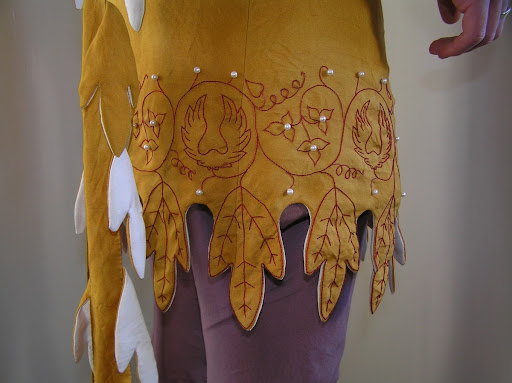
But these terms are not meant to invoke either violence or bloodshed. For they refer to two fancy tailoring techniques that became popular in Europe from the 14th to the 16th centuries for the embellishment of elegant garments.

Dagging is a decorative hem created by pointed motifs, or dagges, that are cut into the edge of a sleeve or the bottom of a blouse or tunic. These could be simple U or V shapes or sometimes more complex designs.

Slashing (also known as "slash-fabric" or "faux chenille") is when multiple layers of contrasting fabric are sewn together and the upper layers artfully sliced open to reveal the colors beneath. The story is told that the technique originated when certain soldiers of the Swiss army sought to keep warm by cutting scraps of material from tents & banners and stuffing them into the chilly holes in their clothing. Upon their return home, the colorful effect of this act of desperation sparked a whole new fashion trend!


Whence comes this sudden interest in tailoring techniques from so long ago? Note the following remark from the pattern notes, explaining the unusual design of the Margaret Tudor sweater:

Slashing is a sophisticated facet of the tailor's art that became extremely fashionable throughout Europe in the 1500s. I have transferred the concept to knitting, together with the strong emblems of The Thistle and The Rose.

So that is why the pattern consists of many individual narrow strips that must then be carefully sewn together. The undulating edges of the thistle panels are designed to overlap the rose panels in such a way as to create "windows" or frames that display the openwork underneath.

As the photo shows, I finished the second thistle panel yesterday. It will be the center front. Notice that unlike the back it ends with a complete motif at the top.

Since the front and the back each have two rose panels flanking the center, and the sleeves each have one down the middle, these first two thistle panels are the only ones with the undulating edges on both sides. The remaining ones will all have that pattern on one side, with the garment shaping of sleeve edge or armhole on the other.

Thursday, July 2, 2009

Defying Gravity

It's uncanny. Call it a Law of Nature. Certain things *ALWAYS* seem to happen, no matter what I do.

When cutting out a new sewing project, for instance, at some point I will inevitably spill my box of pins.

When hand sewing, at some point I will inevitably drop my needle in a random direction and have to hunt all over for it.

And when knitting cables, I will inevitably keep losing track of the @#%&^!! cable needle.

I have been known to slip cable stitches off the needles into mid-air and perform the twists manually, just in order to avoid having to use, and more to the point keep track of, a cable needle.

It's become sort of a sad joke in my life, really.

Things like this bring out my native Slavic fatalism in a big way. You know what I mean: you're not paranoid, those really ARE German Panzer units on the horizon...

Peggy Tudor has some delicate cable work that requires careful attention, and the assistance of a cable needle can be invaluable. So lately, in connection with the thistle panels, I have frequently had to stop & grope around next to me and/or UNDER me, because the silly thing has slipped away & made another bid for freedom.

I have tried all of the obvious fixes, like sticking it in my knitting, or in the skein, or on my lap, or in my mouth. None of them seem to help.

Frustrating doesn't even begin to touch this.

So I was complaining about it last week at that gathering of knitters in Louisville, where the entrelac concept for my Spring Bouquet yarn got its big vote of confidence. The ladies made various creative suggestions, and I admit I was rather dubious at first.

But yesterday, after tracking down the elusive cable needle for the third time in approximately 11 minutes, I finally decided that enough was enough and put one of the ideas to use.

I got some stray bulky yarn out of my stash, and knitted a small seed-stitch rectangle, just the right size to hold the cable needle securely, so that I can pin this object to a convenient spot on my clothing while I am knitting and always have it to hand.

I am happy to report that this embarrassingly simple solution works like an absolute charm. It has *SOLVED* my perennial problem. Gravity is no longer a predatory influence on my cable knitting.

Take that, Isaac Newton!!

Wednesday, July 1, 2009

Peggy Tudor: 1st whole panel

Last night I finally finished the first panel for Peggy Tudor!!

Here it is.

One down, and "only" 15 more to go.

That's 5 each front and back, plus 3 for each sleeve.

So this is just the first big milestone.

I've got some *serious* knitting ahead of me.

But it's lots of fun (even if the pattern requires a bit of concentration).

This will be the center back.

As you can see, there's a partial motif at the top (18 out of 44 rows).

That's in order to allow the center *front* to end on a complete thistle at the neckline.

So this panel consists of (5 x 44) + 18 = 238 rows.

It is a long skinny panel.

I love the elegantly undulating edges with their touch of lace.

They will become a striking feature of the finished sweater.

Of course, what I have here is a LONG SKINNY PICTURE to mark the occasion.

Hence the short, choppy paragraphs, because I needed to fill the space.

TA-DAAAH!!